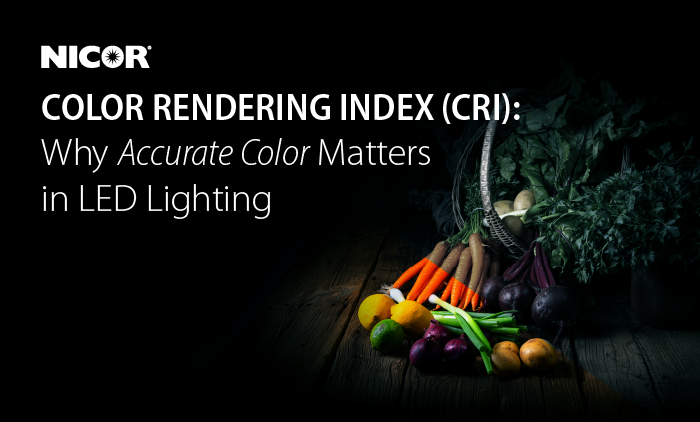
When evaluating LED lighting, brightness and color temperature often get the most attention. However, Color Rendering Index (CRI) is just as critical—especially in environments where color accuracy, visual quality, and comfort matter. Understanding CRI helps you choose lighting that displays colors naturally and enhances the overall appearance of a space.
What Is Color Rendering Index (CRI)?
Color Rendering Index (CRI) is a quantitative measurement of how accurately a light source reveals the true colors of objects compared to a natural light source, such as daylight.
CRI is measured on a scale from 1 to 100:
- A CRI of 100 represents perfect color rendering, similar to natural daylight
- The closer a light source’s CRI is to 100, the more accurately it reproduces colors
LED lights are tested using standardized color samples, and their performance is averaged to produce a CRI score.
Understanding CRI Ratings
Not all LED lights render colors equally. Here’s how CRI levels typically break down:
- Low CRI (CRI ≈ 70):
Colors may appear dull, washed out, or inaccurate. Suitable for basic utility lighting where color accuracy is not critical. - Average CRI (CRI ≈ 80):
The most common rating for commercial and residential lighting. Provides acceptable color accuracy for general use. - High CRI (CRI > 90):
Delivers excellent color accuracy with vivid, natural-looking colors. Ideal for applications where visual quality matters most.
What Is R9 and Why Is It Important?
While general CRI provides a good overall score, it does not tell the full story. One of the most important supplemental metrics is R9, which measures how accurately a light source renders the color red.
- Red wavelengths are essential for accurately displaying skin tones, food, artwork, and fabrics
- Most light sources struggle to render red accurately, making high R9 values difficult to achieve
- R9 is often not included in standard CRI ratings, but it plays a major role in perceived light quality
LED lights with a high R9 value produce richer, more vivid colors and a more natural appearance.
Why High CRI and R9 Matter in LED Lighting
Lighting with a high CRI and strong R9 performance enhances visual comfort and realism. These qualities are especially important in:
- Retail and showroom lighting
- Hospitality and dining spaces
- Healthcare and medical facilities
- Art studios and galleries
- Residential spaces where color accuracy matters
High CRI LED lighting ensures that colors appear true-to-life, improving both aesthetics and functionality.
Choosing the Right CRI for Your Application
When selecting LED lighting, consider both CRI and R9 values, not just brightness and color temperature. For everyday applications, CRI 80 may be sufficient. For premium lighting quality, professional environments, or visually demanding spaces, CRI 90+ with a high R9 value delivers the finest quality of light available today.
Final Thoughts
Color Rendering Index (CRI) is a key factor in lighting performance. High CRI LED lights—especially those with strong R9 values—provide superior color accuracy, vividness, and visual comfort. By choosing lighting with excellent CRI and R9 performance, you ensure your space benefits from the highest-quality illumination possible.

About NICOR Lighting
NICOR Lighting is a U.S.-based manufacturer of high-performance LED lighting and control solutions for residential, commercial, industrial, and outdoor applications. Since 1982, NICOR has helped customers bring projects to life through innovative products that balance performance, reliability, and value. From downlights and architectural fixtures to advanced lighting controls and energy-efficient systems, NICOR delivers solutions designed to meet the demands of today’s built environment.