Area lighting projects, parking lots, site perimeters, industrial yards, live or die on more than the fixture. The pole has to be rated for the wind load, the mounting configuration, and the fixture weight the project calls for, or the whole installation is at risk. NICOR is a manufacturer of commercial and industrial LED lighting and controls, and the OPL4v2 extends that into the structural side of area lighting: a 4-inch square steel light pole engineered for commercial, municipal, and industrial applications.
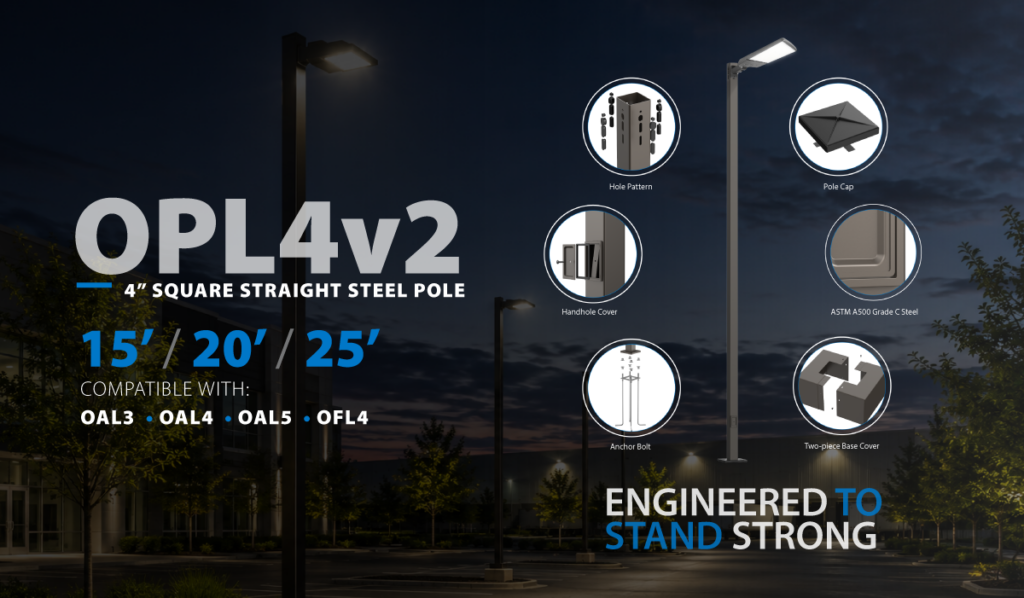
- ASTM A500 Grade C structural steel shaft, 11-gauge wall
- ASTM A36 carbon steel base plate, ASTM F1554 Grade 55 anchor bolts
- Compatible with NICOR’s OAL Series and OFL4 area light fixtures
- Available in 15′, 20′, and 25′ heights
- Stocked poles carry a 5-year limited system warranty; special order poles carry a 1-year limited system warranty
Built to ASTM Structural Standards
Commercial and industrial area lighting projects are held to structural codes, not just photometric ones. The OPL4v2’s pole shaft is fabricated from high-grade structural steel tubing conforming to ASTM A500 Grade C specifications, with an 11-gauge (.120″) wall thickness and minimum yield strength of 50,000 PSI. The fabricated carbon steel base plate conforms to ASTM A36 standards, and the included anchor bolts conform to ASTM F1554 Grade 55 with a minimum yield strength of 55,000 PSI. A reinforced, galvanized sheet-stamped hand hole cover with grounding provisions, and a textured architectural bronze powder coat finish, round out a pole built for long-term outdoor durability and corrosion resistance.
Sized for Parking Lots, Site Lighting, and Area Lighting Projects
Facility owners, contractors, and specifiers planning parking lot lighting, industrial site lighting, or general area lighting need a pole rated for the actual wind conditions and fixture load of the project, not a one-size-fits-all shaft. The OPL4v2 is available in 15′, 20′, and 25′ heights, with wind loading data published by mounting height and pole configuration to support project-specific engineering review.
Compatible with NICOR’s OAL and OFL4 Area Lights
The OPL4v2 is designed to pair directly with NICOR’s OAL Series LED Area Light fixtures (OAL3, OAL4, OAL5), as well as the OFL4 (150W and 320W models, with a tenon adapter). Standard 4-90 drilling configurations and optional tenon mount configurations support a range of fixture and bracket setups on a single pole platform.
Available in 15′, 20′, and 25′ Heights
Each height option is available with a 4-bolt mounting base configuration, four galvanized L-shaped anchor bolts, and a mounting template. Hand holes are positioned 18 inches above the base for accessible wiring, and the assembly includes a removable polycarbonate pole cap and a two-piece formed steel base cover for a finished appearance once installed.
Mounting Options for Any Site Layout
Beyond the standard base mount, the OPL4v2 platform supports bullhorn adapters (180° double, 180° triple, 120° triple, and 90° quad configurations), wall mount brackets (90° and 180°), and a tenon adapter, giving specifiers flexibility to configure a single pole platform to a range of site layouts and fixture counts.
Warranty
Stocked poles carry NICOR’s 5-year limited system warranty. Special order poles carry a 1-year limited system warranty.
The OPL4v2 is available now through NICOR’s agent and distributor network. For compatible fixtures, browse NICOR’s OAL Series Area Lights, or see NICOR’s full outdoor lighting solutions for more on lighting built for exterior commercial and industrial sites.

About NICOR Lighting
NICOR Lighting is a U.S.-based manufacturer of high-performance LED lighting and control solutions for residential, commercial, industrial, and outdoor applications. Since 1982, NICOR has helped customers bring projects to life through innovative products that balance performance, reliability, and value. From downlights and architectural fixtures to advanced lighting controls and energy-efficient systems, NICOR delivers solutions designed to meet the demands of today’s built environment.